“The world is changing, and our outlook needs to change with it, because old models don’t cut it anymore…”
– Blake Ross, co-founder of Firefox web browser, downloaded over 300 million times worldwide

“The world is changing, and our outlook needs to change with it, because old models don’t cut it anymore…”
– Blake Ross, co-founder of Firefox web browser, downloaded over 300 million times worldwide

So I just got back from my first trip to Las Vegas last week to visit Felisha’s cousin and celebrate our anniversary… So what was my impression of the famous Vegas?
Money, Sex, Excess.
Yep, I guess that pretty much sums it up!
But one thing that really stood out from the trip besides the incredible heat, was the Cirque Du Soleil show we partly went there to see called ‘Ka’
This show defies any type of description, so I won’t attempt, but I will tell you that it was the most incredible live show I’ve ever seen, complete with 360 degree sound, a custom built theatre, and the most high tech, modular, mobile stage in the world. It was truly beyond belief, and it not only puts any live theatre show out there to shame, it makes Phantom Of The Opera look like an elementary school play.
Get a peek here:
In my last post I talked about how the quality and natural dynamics of music is being destroyed through digital software technology that allows unnatural processing of audio.
But there is a much greater threat to the quality of audio that has been the subject of my thoughts for some time now: The way we listen to sound.
Back in the 1970’s the quality of sound recording technology, production techniques and playback systems reached a pinnacle with some of the most incredible music and sound humanity had ever known, and this became further fine tuned in the 1980’s. Brilliant, rich full spectrum sound that went beyond the range of human hearing, but influenced the richness of the sound through frequency harmonics that enhanced what we could hear with our ears.
Two things initiated the downward spiral that has led us to where we are today: The Walkman and the CD.
Very briefly, the walkman influenced music lovers to listen to music on crappy little earphones, and the CD chopped off audio at 20kHz without researching the influence of harmonics above that hearing range on sound we do hear. This is why vinyl records really are better sounding than CD’s in many ways.
From there, the convenience of sound gave way to clarity, and quality until we come to the present day world, of massively widespread use by the majority of music and audio listeners of terrible sounding MP3’s played on the worst possible sound producing devices humanity has ever experienced: earbud iPod headphones, computer laptop speakers, and cel phones! And this doesn’t even begin to cover the music and production tools and techniques prevalent with the trend of do it yourself computer production.
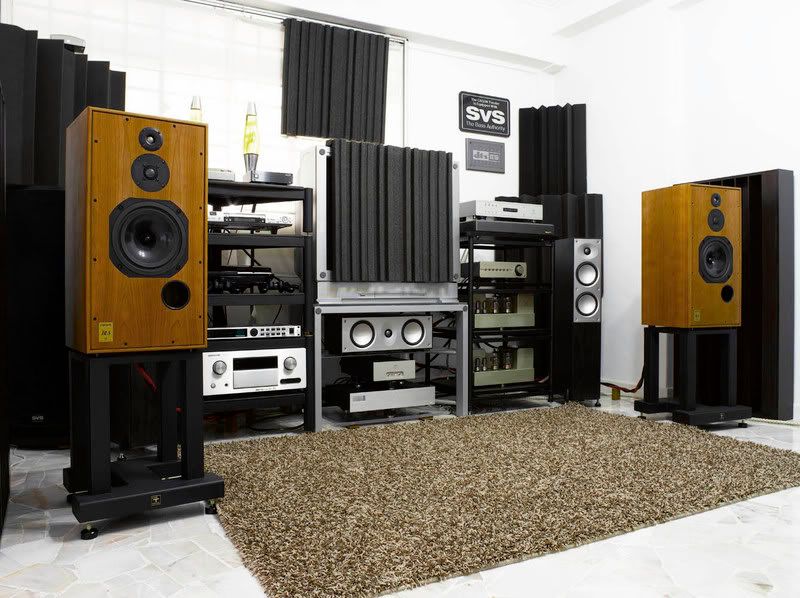
To a producer like myself who has spent over a decade mastering the subtle art of trying to perfect music and sound, this trend is devastating to say the least. And if you ever compared how music sounds on a really nice hi fi stereo system (you know like the ones they used in the 70’s) with a computer laptop speaker, it would make you nauseous. You lose something like 80% of the sound! But that introduces another problem- people don’t really know what sounds good and what doesn’t, maybe because they have become so used to listening to terribly reproduced sound, in my humble opinion and experience.
(Just as a benchmark, and cost is by no means an accurate measure, if your speakers cost less than $500, they are probably cheap garbage that sounds terrible!)
This has brought up all kinds of questions for me with regard to what I do as a profession… Why create great sounding 24 bit 96kHz audio if it is going to end up at 80% of what you created? For the 20% of people that like good sound?
My only answer is to become more involved in the film industry side of audio production as a sound designer, since at least sound is formatted and reproduced in higher fidelity than with music. So that is what I have gradually been doing. A film I worked on last year is hitting the theatres in September here…
I truly feel for the future of music in an environment where it is so under appreciated. It makes me wonder what the future holds for someone in a profession like myself and wether or not there will even be the need for professional producers and engineers if no one can really appreciate or notice their efforts.
For those of you reading this who don’t really know what I’m talking about, you don’t know what your missing!
For some time now there has been a debate about how modern audio mastering techniques have created music that is louder than it usually would be at the expense of the normal dynamics of the music.
Andrew Dubber blogged about it here with a video that demonstrates the issue:
The process of making tracks louder than they usually would be without them distorting is called ‘Limiting‘.
This is something, as an audio engineer that also does mastering, that I have wrestled with for many years. I like music loud, and it bothers me when something sounds too quiet when listened to with other music. But as a producer and sound mixer, I also love dynamics in music. When others have mastered songs I’ve mixed using standard ompression, it has really ruined the song. But you don’t want the music to seem quiet compared to other music, and you want it to sound good on the lousy stereo systems most people listen to music on! Hence the Dilemma.
I think that in many ways, Dubbers argument may be pointless really. The majority of people in the world wouldn’t know good sound if their life depended on it! Even many of the talented artists I work with for whom music is their life struggle with this, and my production students certainly do as well.
I blogged more about this major issue of the poor quality audio so prevalent in the world here.
Alan Wilder of Recoil and formerly Depeche Mode wrote an excellent article about it and about other industry changes as well here
.
This is a more personal post, something I shy away from on this blog. I had to create a new category for it. Will be interesting to see if it becomes published material…
Over the years, as I have explored new ideas and learned hard lessons, it is painfully evident that I am becoming someone I’m not, very different from who I feel I used to be, who I really am. It’s something I’m really wrestling with amongst many other challenges in my life. But what defines who we really are? We’re constantly bombarded with people encouraging us to ‘be who we are’ and ‘be true to yourself’, ‘don’t take crap from anyone’, but I think that these ideas can be a hindrance to personal progress and development.
But I’m still very torn about this idea. I know the changes I’ve made in my life and regarding who I am have made a huge difference in my relationships with others, and my work and goals. It’s a very positive thing. But humans find change very difficult, and I’m no exception. The hardest part about this process is that I feel I am losing many of the things I have always felt defined me as a person, my brutal honesty and affinity with reality, my anti establishment, counter culture, non conformist rebelliousness, and my taste in many things that are unpopular to say the least, especially music. These are traits that are slowly diminishing as a result of my becoming an upstanding, exemplary individual.
But when those things hurt others who are sensitive deeply, and destroy precious relationships, and hold you back from realising your true potential, that’s where I feel motivated to ‘be who I am truly meant to be’, the person I hope I am becoming.
There’s a great rock song by Linkin Park ‘What I’ve Done’ that I posted about here on this subject.
I love the line in those lyrics, ” I’ll face myself, To cross out what I’ve become, Erase myself, And let go of what I’ve done”
Who knows if who we think we are is really who we were meant to be? We are total victims of our environment and upbringing, totally influenced by the world, as my favorite quote reveals. Does the end result really represent our true selves? I have come to the realisation that in the transformation that has been happening over the last 10 years or so, and will continue for another 10 or more, that in order to live to my full potential, and be who I am meant to be, I have had to unlearn many things from my past, in order to accept new ideas and be who I truly am, the person I am meant to be.
It seems in order to do that, I’m just going to have to somehow become detached from the things I ‘was’.
Check back with me in 10 years and I’ll let you know how it’s going.
For some time now I, along with many others in the music industry, have been going on about free music not representing a lost sale, but a gained listener.
Frequently, many music industry professionals suggest that an increase in legitimate sales must necessarily coincide with a commensurate reduction in ‘piracy’, as if this were a fact, yet, the research company BigChampagne has made no such consistent observation in nearly a decade of analyzing online data about music. Rather, it finds that piracy rates follow awareness and interest… The biggest selling albums and songs are nearly always the most widely pirated, regardless of all the ‘anti-piracy’ tactics employed by music companies.
Wired magazine talked about the factual data supporting mega rock band Radiohead‘s decision to allow users to pay what they wanted for their latest album.
All of the torrenting/free downloading of Radiohead’s of In Rainbows album contributed to the album making such a big impression on a listening public that’s bombarded with an ever increasing amount of information. Without it having been so widely traded, BigChampage’s data report says that Radiohead’s album wouldn’t necessarily have shot to the top of the charts and their worldwide tour wouldn’t have been such a smashing success, and I have to agree.
Applying economic principles to digital music, BigChamagne found that “the challenge of achieving popularity (or attention) when the old rules of scarcity (of product) and excludability don’t apply (to information goods) the way they used to, changes the monetization game completely.”
BigChamagne came to the undeniable conclusion that the music industry needs to stop thinking of shared files as lost sales, and start treating them as an aspect of reality upon which they can build part of their businesses.
You can download a detailed paper on this topic here. I haven’t studied it in detail yet so I would love to hear your insights.
So I’m thoroughly embarrassed to admit it, especially publicly, but I like a few of the new Coldplay tracks on their new album. Their sound isn’t really my thing, but they have some more edgy, upbeat and interesting production on songs like Viva La Vida (my current fave song) and Violet Hill from the new album.
But when I went to their website, there was no music! Oh, except for a free song that was so poor, it was a slap in my face. NO MUSIC ON A BAND WEBSITE?? How does this kind of thing happen? Maybe it was there and I just didn’t see it? That is just as bad.
Note to major labels, if your going to jump on the ‘free song’ bandwagon, if you offer a lousy track, it is like the 30 second preview, it’s just a slap in the music fans face!
But eliminating the entire music section from an artist website? That is beyond belief.
You know the only place online you can hear more than one full length song from the new Coldplay album? ‘Illegal download’ torrent sites.
But since they offer non DRM tracks on iTunes, perhaps I will get a few songs from there… Maybe.
“When the winds of change are blowing, some people are building shelters, and others are building windmills”
– ancient Chinese proverb
Which one do you want to be, in this hurricane that has hit the music industry and business in general?
From Soundscan stats released at the yearly NARM conference:
– 80,000 Records were released in total in 2008
– 80 percent of them sold less than 100 copies each.
– Most sales were from only 1000 titles
– Only 10 percent of hit records represent actually purchased music
And regarding copyright according to Andrew Dubber:
“It’s estimated that less than 2% of all music that has ever been released in a commercial format is currently for sale in any way, shape or form. That 6-million tracks thing that iTunes goes on about is hardly even the tip of the iceberg.” (Because of corporate ‘copyright hording’, preventing creators from access to their own works)
There are many more, but I don’t want to overwhelm you…
I’ve just finished producing a fantastic new cover song for Heather Doré’s Pop music debut. I’ll tell you more about it soon when she launches it. She is a 21st century artist, so she is releasing her music, as it is completed, from her website, and you don’t have to wait, you can get it right away!
But releasing a cover song for digital distribution only from her own website has proven to be complicated as many simple things are in the music industry as it is overrun with paranoid obsession and unbelievable bureaucracy…
If you want to release on CD, or on iTunes within the country it was produced, then it is much more simple, but on your own website, where anyone in the world can buy it? Problems.
This is because the music industry works on a per country basis, that’s why it took forever to get iTunes in most countries because of all the deals and paperwork they had to do for practically every song.
That’s right, the corporate music industry complains, bitches, moans, publicizes and sues about losing money, but they make you jump through hoops and practically give up your first born child to help them make money with their music! Just give us what we want! How simple is that? It’s what, the first rule of business or something? Give the customer what they want. How could scores of billion dollar corporations worldwide forget that rule? It seems intense greed and lust for power blinds one quite severely, and this is why they’re losing money, NOT because of downloading. They would rather destroy their entire business before making it easy for you to give them money.
Good, change is good, and this is all causing music business to move back in the hands of the artist, making the importance of good music key. And that is a very good thing! Ok, rant over.
Basically I am still on the phone with the Canadian Music Rights Reproduction Agency and the song publisher regarding the song, so I don’t have any definitive answers for you. (The CMRRA doesn’t even have anything about digital distribution on their website, but at least we have such an agency to make some things a bit easier than they would be with payment of mechanical royalties in Canada)
What I can tell you is iTunes has done a deal where they pay out royalties as required for sales in each country for cover songs sold, so that simplifies things when releasing cover songs digitally this way.
But if you want to sell the songs on your own website to the world, which is my recommended method of selling music (NOT on myspace or facebook, but on www.yourname.com personal website), you have to obtain special rights for the world to sell the song, AND pay monthly royalties to the publisher yourself with detailed financial statements. And you may have to negotiate with different publishers for different parts of the world. Imagine having to negotiate with 3 or 4 publishers for each country in the world just to sell a song digitally from your website! Within 5 years, most music will be sold electronically!
So you think, ok how hard can that be, you just pay online at the publishers website with a credit card, right? Sorry, you must be taking about an industry that is efficient, progressive and meets the needs of it’s customers, and that’s not how the music industry works, and that is one of the many reasons why they are losing money.
Needless to say we aren’t going to work on many cover songs any more, as fun as it may be.